17

Experiments
Introduction
Classification
Time-multiplexing
Spatial codification
Direct codification
Formació

Time-multiplexing: hybrid methods
(I)
• In order to decode an illuminated point it is
necessary to observe not only the sequence of intensities received by such a point
but also the intensities of few (normally 2) adjacent points
• The number of projected patterns reduces thanks to the spatial
information that is taken into account
• The
redundancy on the binary codification
is eliminated

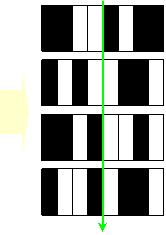
Hall-Holt and Rusinkiewicz
technique:
4 patterns with 111 binary
stripes
Edges encoding:
4x2 bits (every adjacent stripe
is a bit)
1
1
1
1
1
0
0
0
Pattern 1
Pattern 2
Pattern 3
Pattern 4
Edge codeword: 10110101
Conclusions
